
When an engineer starts speccing a custom plastic part, the conversation usually opens with material – HDPE, UHMW-PE, TPU, nylon. But the manufacturing process behind that material matters just as much, and it gets discussed far less. Two methods dominate industrial plastic manufacturing: screw extrusion and ram extrusion. From the outside they look similar – raw polymer goes in, a shaped profile comes out – but the way each one moves and melts material is fundamentally different, and that difference decides which materials, part geometries, and production volumes are actually realistic. Many custom plastic extrusion projects hinge on getting this decision right before tooling ever gets cut. This guide breaks down how each process works, why the industry runs both instead of standardizing on one, and how to figure out which your part needs.
What Is Screw Extrusion?
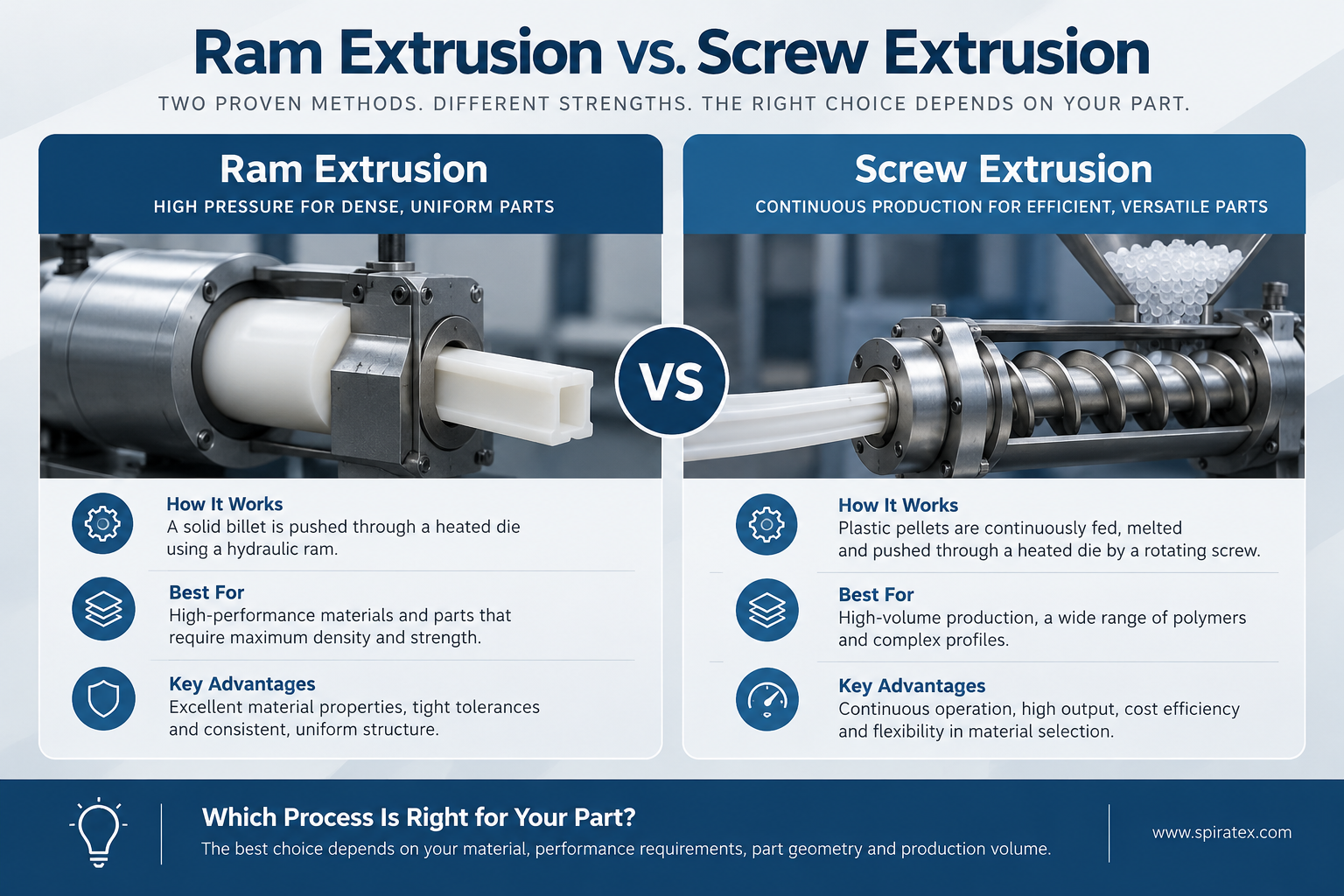
Screw extrusion is a continuous process. A rotating screw – single or twin – pulls plastic pellets or powder through a heated barrel, melting and homogenizing the material through a combination of heat and mechanical shear before pushing it through a die to form the final profile. Because it runs continuously rather than in discrete batches, it’s the industry’s default for high-volume production of common thermoplastics with stable, moderate melt viscosity – materials like HDPE and LDPE that flow predictably once melted.
The screw itself does double duty: it conveys the material forward and works it enough to mix in colorants, additives, or fillers along the way. That’s a real advantage for standard parts, but it depends on the polymer actually being willing to flow past a rotating screw without excessive resistance.
What Is Ram Extrusion?
Ram extrusion works on a different principle entirely. Instead of a rotating screw, a hydraulic ram (piston) pushes a preheated billet of material through a die in a discrete, batch-by-batch cycle – there’s no continuous feed and no screw shearing the polymer as it moves. This matters because some polymers can’t be processed the other way. Ultra-high molecular weight polyethylene is the clearest example: its extremely long molecular chains give it such high melt viscosity that a rotating screw struggles to push it forward at all, and the shear involved can degrade the material or overload the equipment. Ram extrusion exists largely because materials like this needed a process that didn’t rely on screw-driven flow.
The trade-off is throughput. Ram extrusion is quasi-continuous at best – each cycle involves loading, compressing, and extruding a new billet – so it runs slower than a comparable screw line. For a material that a screw simply can’t process well, that trade-off is the cost of using it at all, not a downside to weigh against alternatives. Understanding ultra-high molecular weight polyethylene‘s behavior under heat and pressure is really what explains why this second process had to exist.
Key Differences at a Glance
| Screw Extrusion | Ram Extrusion | |
| Process type | Continuous | Batch (quasi-continuous) |
| Material moved by | Rotating screw | Hydraulic ram/piston |
| Best suited to | Standard thermoplastics with moderate, stable melt viscosity (HDPE, LDPE) | High-viscosity, hard-to-melt polymers (UHMW-PE, PTFE) |
| Shear/heat exposure | Higher — screw imparts continuous shear | Lower — material isn’t sheared by a moving screw |
| Throughput | High | Lower, cycle-dependent |
Can UHMW-PE Be Extruded on a Standard Screw Extruder?
Not effectively, in most cases. UHMW-PE’s exceptionally long molecular chains and high melt viscosity mean it resists being conveyed forward by a rotating screw – the polymer can slip against the screw rather than move with it, building up back-pressure that risks degrading the material or straining the equipment. This is precisely why ram extrusion developed as a dedicated process for this and similarly difficult polymers like PTFE.
It’s worth noting this isn’t a fringe engineering problem – the challenge of processing UHMW tubing and profiles from this material has been studied directly in materials-science research on extrusion processing of ultra-high molecular weight polyethylene, which documents exactly why conventional screw equipment struggles with it. Some specialized screw designs (grooved-barrel systems, twin-screw configurations) have been developed to work around the limitation, but ram extrusion remains the more established, lower-risk route for this material class.
Why It Matters When a Supplier Runs Both Processes In-House
If your project’s material choice isn’t finalized yet – or might change during development — the extrusion process becomes a sourcing consideration, not just a technical one. A supplier that only runs screw lines can’t take on a part that needs UHMW-PE or another ram-extrusion-only material without subcontracting that step out, which adds a vendor, a handoff, and a delay to your supply chain. The reverse is also true: a shop set up only for ram extrusion isn’t the efficient choice for a high-volume HDPE run.
Working with a plastic extrusion manufacturer that operates both processes under one roof removes that constraint. It means a material change mid-project doesn’t force a vendor change, tooling and quality control stay under one point of accountability instead of being split across two shops, and there’s one team – not two – troubleshooting if a part isn’t performing as expected. For any part where the final material isn’t locked in early, that flexibility is worth weighing as seriously as price or lead time.
Matching the Process to Your Part
A few questions help narrow down which process actually fits a given part:
- What’s the material’s melt behavior? If it’s a standard thermoplastic with predictable, moderate viscosity, screw extrusion is almost always the right call. If it’s UHMW-PE, PTFE, or another polymer known for extreme viscosity or poor melt flow, ram extrusion is likely required.
- What volume are you producing? High-volume runs favor the continuous throughput of screw extrusion; lower-volume or highly specialized runs are less penalized by ram extrusion’s batch cycle.
- How sensitive is the part to shear or thermal degradation? Materials or applications where shear-induced property loss is a concern lean toward ram extrusion.
- Is the material decision final? If there’s a chance the spec shifts to a harder-to-process polymer, it’s worth confirming upfront whether your plastic extrusion manufacturer can handle that shift without re-sourcing the job.
Getting these answers early – ideally before a drawing gets finalized – avoids the more expensive version of this conversation, which happens after tooling is already cut for the wrong process.
Conclusion
The choice between ram and screw extrusion was never about which process is “better.” It’s about matching a manufacturing method to how a specific polymer actually behaves under heat and pressure, and to the production volume the part realistically needs. Get that match right at the spec stage, and the rest of the manufacturing conversation – tooling, tolerances, lead time – gets a lot more straightforward.
If you’re working through this decision for a specific part, Spiratex’s engineering team can help you match material and process before you tool anything.
